The World Refused to Cooperate: How Disillusionment Shaped My Decades-Long Body of Work
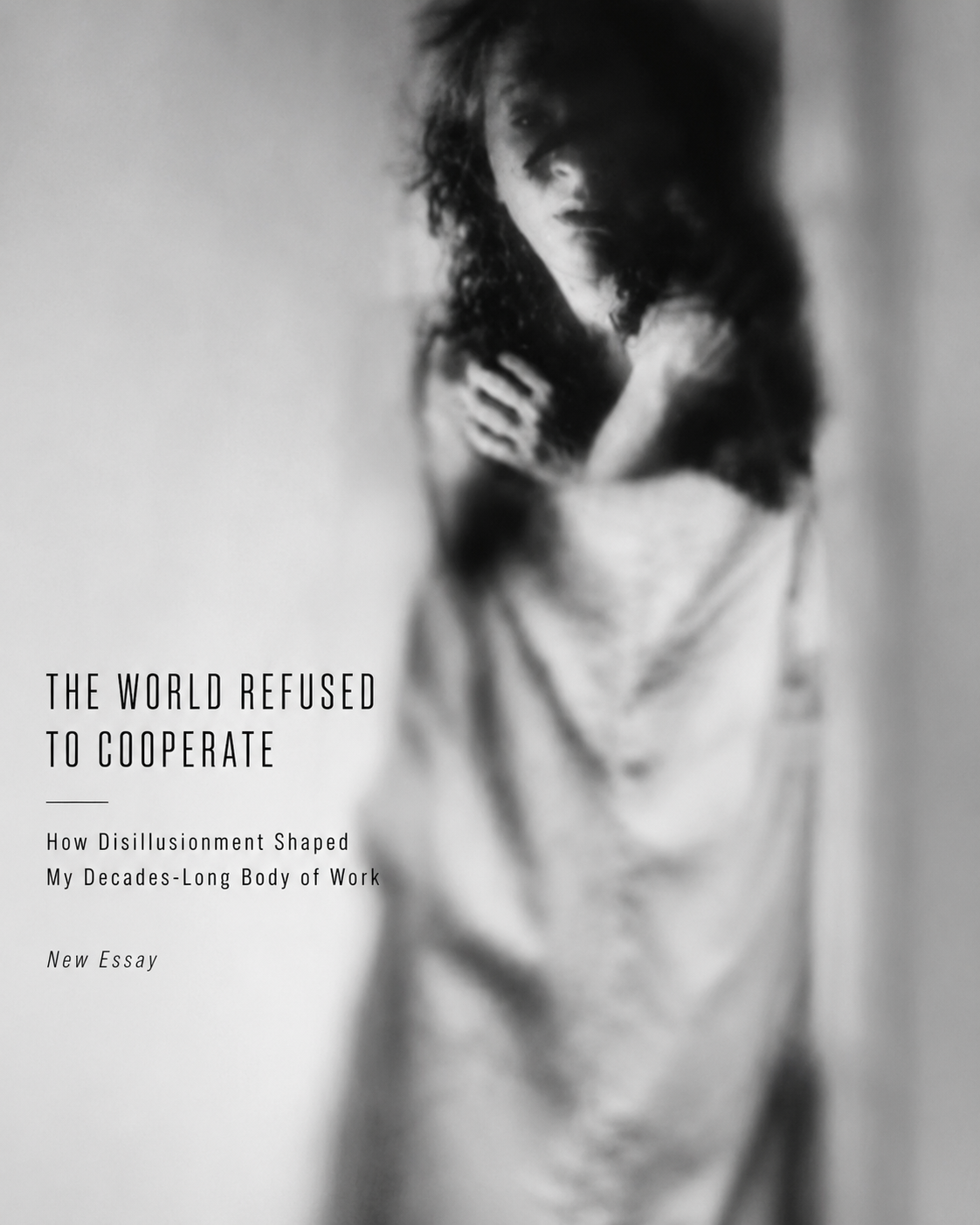
I have often been questioned about why certain themes—grief, memory, identity, and social critique— continue to reappear throughout my work.
Viewed from the outside, my projects may seem disconnected. One body of work examines my mother's blindness and death. Another explores memory and dreams. Others address women's autonomy, political disinformation, artificial intelligence, environmental change, life in a tourist playground, or the instability of photography itself.
The subjects are different.
Yet I have never experienced the projects as separate.
I always knew the connection between them. The problem was that I could not adequately explain to others what it was.
The answer begins with disillusionment.
I do not mean disappointment. I mean those moments when reality can no longer be explained by the story we have been telling ourselves about it.
That does not mean the story was false; it means it was incomplete.
For example: My mother's blindness forced me to think differently about perception. Her death forced me to think differently about memory.
Both left me with questions. What does it mean to see? What does it mean to remember? How much of either occurs in the world, and how much occurs within us?
Years later, when my husband abruptly left our family for another woman—an employee 30 years his junior—I found myself confronting a different kind of uncertainty. The evidence and just about everyone who knew the situation suggested one conclusion: divorce. Yet I believed and acted upon another (and in the end, he returned, and we are still married).
That experience taught me how hard it can be to distinguish between faith and denial, intuition and self-deception, evidence and interpretation. Reality is more complicated than the explanations we construct around it.
Watching large segments of American society embrace demonstrably false narratives raised related questions. How do people decide what counts as evidence? Why do some beliefs survive overwhelming evidence while others collapse under much less pressure? What happens when competing versions of “reality” become impossible to reconcile?
Grief, memory, identity, and social critique are not the ultimate subjects of my work; they are the circumstances that force me to question my life and the world around me. How do we understand our lives when what we experience no longer fits the stories we use to explain it?
The work emerges from those questions, but it also serves another purpose. Catharsis is as necessary to me as breathing.
Photography and a lens have remained central to my practice because they occupy the same territory. We continue to treat photographs as evidence even though we know they are interpretations. We trust them while understanding how easily they can mislead us. The medium exists in the uneasy space between certainty and uncertainty, between truth and fiction.
Add AI-generated, photographically styled imagery to the mix, and the relationship between photography, evidence, and belief becomes even more complicated.
My relationship to technology emerged from necessity rather than a fascination with innovation. I rarely had access to a darkroom outside of my undergraduate and graduate classes. With a son who was a pre-kindergartner, spending long hours in campus labs was NOT an option. (Yes, I was a reentry student with a husband who worked very long hours and no budget for childcare.) If I wanted to continue making work, I needed tools that allowed me to work from home. Digital processes provided that.
I adopted Photoshop in the 1990s because it allowed me to create images that would have been difficult or impossible to realize through traditional photographic processes alone. I began making and exhibiting inkjet prints in 1999, not because I was trying to be technologically progressive, but because I needed a way to print my work. These technologies were not replacing photography; they were expanding what photography could do and where I could work. The move toward digital collage, digital and traditional drawing, painting, and encaustic emerged for similar reasons. There were ideas and experiences I wanted to communicate that photography alone could not adequately express. Straight photographic description felt insufficient. My ideas required metaphor, ambiguity, invention, and the layering of multiple realities. Digital processes allowed me to combine techniques in ways that more closely reflected how the concepts I worked with actually functioned.
I was not abandoning photography.
I was pushing beyond its descriptive limits.
I am what I jokingly call a “lazytographer.” I have never been interested in carrying large cameras or toting gear. I also don’t care at all about image perfection; I only learn as much as I need to make my work say what I want it to, and those things some perceive as flaws are conceptual necessities in my work. Yet these are the same things some photographers seem to obsess over, to the point that their images are dull and flat and say nothing more than “Here is what I saw on my walk today.” Punctum? Totally lacking. Concept? Non-existent. My interest level in that kind of work? Zero.
I began using mobile phones as a primary camera in 2003, years before smartphones became ubiquitous. They allowed me to work with minimal equipment, something that appealed to both my impatient temperament and my life circumstances.
When the iPhone and its apps appeared, they gave me the effective equivalent of a portable studio in the palm of my hand. The transition felt natural because the early applications borrowed concepts from Photoshop, something I knew so well that I could execute using it while in a coma if need be. Add in the Pro version of the iPad, an Apple Pencil, and Procreate, and I literally had everything I needed in a format I could use anywhere. What interested me was not the technology itself. It was the freedom the technology provided.
In graduate school, one of my mentors, Chris Peregoy, introduced me to modifying toy and Polaroid cameras. That demonstrated that cameras were not fixed objects, but tools that could be altered, adapted, and pushed beyond their intended purpose. Years later, I applied the same approach to mobile phones.
People laugh when they see them, but I often work with older iPhones fitted with plastic toy camera lenses, sometimes attached with little more than duct and gaffer’s tapes. I am drawn to these because they allow me to impose a distinctly personal visual language onto a digital technology. The imperfections matter. The distortions matter. The image becomes less about what the camera records and more about how I experienced a particular moment.
My approach is also deeply personal. When I encounter a scene I believe my acutely low-sighted mother would have enjoyed, I place materials in front of the lens—whatever happens to be available at the time—to obscure, diffuse, or transform the view. The resulting images—the Legally Blind series—become a collaboration amongst my memory, perception, and place. It is not a straightforward visual description of what was in front of me. It is an emotional experience.
For nearly two decades, I was repeatedly told that the work I created with digital tools was “not really art, because the computer made it.” BUT…The computer never made the work. I did. The computer was just one of the tools I used to translate an experience into an image. Digital processes allowed me to move further away from description and closer to what I wanted to express. My goal was never to reproduce what I saw.
It was to express what I experienced.
I have always known that the tools themselves were never the point. Regardless of media employed, I was asking variations of the same questions. I choose my media to support my conceptual concerns. That remains true to this day. My overarching mantra is “How do I create images that convey not simply what I saw, but what I experienced, remembered, believed, feared, or understood?”
Disillusionment is what set those questions in motion.
Not because disillusion provides answers. It doesn't. It forces questions that can no longer be ignored.
My themes and projects change. My technologies change. My materials change.
Yet the questions have remained remarkably consistent.
Three decades later, I am still asking them.