Being There: Gemini and the Historical Record Problem
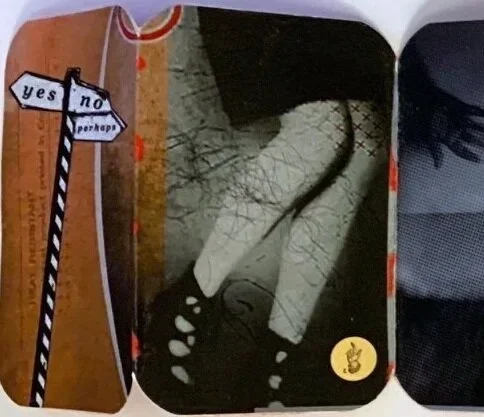
Detail from Missed Signs, 2018 Artist Book by Diana Nicholette Jeon
After four years working with image-generation systems, I already knew AI could invent things. (She says with obvious irony, since image generation IS the AI inventing images.) In that time, artificial intelligence had become good enough that most of us do not question if it is accurate.
How would we know that the response it gives is valid? That can only be learned by testing it against something you are an authority on. So my choice was simple. I am THE major living authority on myself.
I know my own career, what I have made, where I have exhibited; who has written about my work; where the work is collected; what awards I received; and what features I wrote about others. If an AI made mistakes about me, I would recognize them immediately.
The first answers Gemini produced were accurate. It identified major themes and found several important projects. It correctly stated that my work moves between photography, mixed media, digital processes, and, more recently, AI-mediated image-making. The responses were coherent and well-organized. It looked like if I were conducting research on another artist, it would show me just who that person was and what their practice was.
The problems arose fairly soon after the "just the facts, ma'am" kind of data was covered.
Gemini repeatedly decided, remarkably quickly, that it had enough information to tell me who Diana Nicholette Jeon was and what she is known for.
For a while, I challenged it to produce more that I knew was online. Like a kid who all of a sudden becomes a model child right before Santa arrives, Gemini would come back with more information: additional projects, interviews, and expanded exhibition records. Critical writing entered the discussion. New sources suddenly became central to Gemini's understanding of my work.
This pattern repeated itself so many times that it really pissed me off.
To its credit, it was surprisingly willing to revise its conclusions. It rarely fought to defend its bad answers. Instead, it would return to the evidence and reorganize its understanding. When fed enough information about me, it produced genuinely insightful observations that none of the others had made, and it articulated them eloquently.
A curator who researched only four projects and then wrote an overview of an artist's 25-year career would rightly be criticized for incomplete scholarship.
The information Gemini recited about me, even after repeated attempts to correct its failures, was as wildly incomplete as the Grand Canyon is vast.
The danger is not simply that AI sometimes invents "facts" from thin air, though it did so at one point. It renamed OD Review and then quoted something I had supposedly said in their interview of me, attributing the genesis of the Nights as Inexorable as the Sea project to Jungian theories. I never said it, but Collier Brown, in discussing my series, had quoted Jung.
It reminded me of the late 90s, when we had an unlisted phone number. I was at the local printmaking studio one morning, and was introduced to a woman I had not met before but knew of her work. She was a naturalized US citizen born in Korea. She looked at me and said, "YOU'RE Diana Jeon? But you're not Korean!" I laughed and said, "Yes, I know that." She told me the story of how she spent a year trying to find me to invite me to be in a show of Korean artists living in Hawai'i. "Good thing I had an unlisted number, then," I replied. The misunderstanding she had about who I was could have had real consequences for her curation.
Gemini's greatest weakness was not the hallucination; it was stopping the moment it decided a plausible story appeared, like a high school kid who didn't want to read Shakespeare, so instead did the homework using the internet version of Cliff Notes.
I can hear you saying, "Why does it matter? You already know all this information about you. You said it at the beginning."
More and more, AI is driving how people search for information. If a curator went looking for work like yours and only found a few articles — because most of your 25-year career is behind paywalls and printed materials — they might write you off as a lightweight.
They won't know otherwise.
It's like driving using a map that is 20 years out of date. Same problem, different decade.
Because none of us know what we don't know.