Teaching ChatGPT the Shape of Your Voice
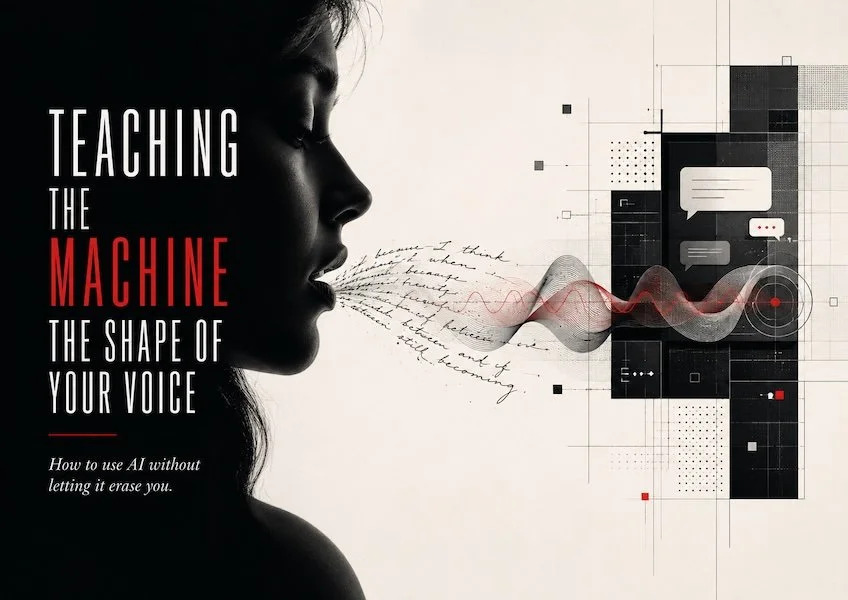
an example of ALT Text for this image: A shadowed woman speaks a stream of handwriting and sound waves into an abstract AI interface, beside the title “Teaching the Machine the Shape of Your Voice.”
A voice skill is not about making AI imitate you. It is about teaching the machine what not to erase.
For a long time, people have been told to think of artificial intelligence as a tool.
That is not wrong.
But it is also not enough.
A hammer does not need to know whether I am building a house, repairing a chair, or smashing something that has outlived its usefulness. A language model does. Or at least, it needs to know enough not to sand everything down into the same shiny, neutral, bloodless object.
That is where skills matter.
By “skill,” I do not mean magic. I do not mean handing the machine a secret code and watching it become sentient, loyal, or wise. I mean something much more practical. A skill is a set of instructions that tells the system how to work with you. Not in general. Not as an abstract user. You.
It is the difference between asking AI to “write this better” and asking it to preserve your meaning, your cadence, your anger, your humor, your grief, your skepticism, and your point of view while making the work stronger.
Those are not the same request.
Most automated writing help has historically been built around correction. Fix the grammar. Smooth the sentence. Make it professional. Make it clear. Make it acceptable. The problem is that “acceptable” is often where interesting writing goes to die.
Artists know this. Writers know this. Anyone who has ever had a meaningful sentence flattened by an editor, a committee, a grant application, a museum brochure, or a well-meaning friend knows this.
The danger is not only that AI will write badly.
The greater danger is that AI will write plausibly.
It will produce something clean enough to pass. Something polished enough to seem useful. Something structured enough to look finished. And if you are tired, overworked, trying to get the website updated, the essay posted, the SEO done, the schema fixed, the grant drafted, the spreadsheet built, and the social image made before dinner, plausible can start to look like good.
That is how voice gets lost.
Not all at once. Not dramatically. Not with a declaration.
It gets lost one softened sentence at a time.
This is why building a reusable voice skill matters. It gives the machine a map of what not to destroy.
In my case, I asked for a skill that was effectively “the Diana voice.” That sounds ridiculous until you realize it is exactly the kind of thing AI needs to be told. The system does not automatically know that I do not want artspeak. It does not know that I would rather have a clean, sharp sentence than a decorative one. It does not know that “elevated” language often makes me suspicious. It does not know that my work comes out of memory, loss, disillusionment, autonomy, and the long historical problem of women’s work not being seen until someone needs it for a footnote.
It has to be told.
So we built the skill.
The instruction was not to make my writing prettier. That would have been the wrong goal. The instruction was to preserve the intelligence, the wound, the humor, and the steel. To keep the voice direct, conversational, analytical, emotionally honest, skeptical when warranted, and occasionally caustic without turning it into performance. To avoid generic AI smoothness. To avoid inspirational mush. To avoid MFA brochure language. To stop sanding off the edges that make the writing mine.
That last part matters.
Because the machine is very good at sanding.
It can take a sentence with heat in it and turn it into a polite observation. It can take lived experience and turn it into a “theme.” It can take rage and make it “concern.” It can take grief and make it “reflection.” It can take a woman saying, “This happened, and I know what I saw,” and turn it into, “This raises important questions.”
No thank you.
The point of a voice skill is not to make AI imitate you like a parlor trick. It is to make the collaboration less stupid.
It means that when I ask for help with an essay, the system has a better chance of understanding what kind of help I actually want. Not a personality transplant. Not a corporate rewrite. Not a smoothing operation disguised as improvement. I want structure when the structure is weak. I want clarity when I have buried the point. I want rhythm tightened, repetition noticed, weak transitions called out, and the ending sharpened. I want the machine to help me make the piece more itself.
That is a very different thing from making it sound like everything else.
This conversation became a small example of what that looks like.
I asked for a reusable Diana voice skill. The system distilled what it had learned from working with me: that my writing is direct, skeptical, personal, unsentimental, and rooted in the gap between what exists and what gets seen. It recognized that I do not want vague art language or generic polish. It named the recurring territory: memory, loss, disillusionment, autonomy, AI interpretation, women’s work, the historical record, and the failures of systems that mistake partial visibility for truth.
Then it turned that into a working instruction.
When I reacted with “Woah. Amazing,” the response was not, “Thank you, I am glad that was helpful.” It said the thing underneath the thing: that the voice was already consistent. The task was not invention. It was recognition.
That is also the larger point.
A useful AI system does not only generate. It notices.
It notices patterns. It notices preferences. It notices what you keep correcting. It notices which words you reject. It notices when “polished” is not a compliment. It notices that you are not asking to be made more palatable. You are asking to be made more legible without being made smaller.
For artists and writers, this is not a minor distinction.
We live inside our voices. They are not decorative. They are the record of how we think. They carry the pressure of our lives, our histories, our refusals, our obsessions, our injuries, our jokes, and our forms of attention. A voice is not just style. It is evidence.
So when we use AI without teaching it how to handle that evidence, we risk letting the machine misfile us.
The answer is not to avoid the tool. I have no interest in pretending I am too pure for technology. I worked in Silicon Valley long before people started treating software like a mystical weather system. I have used Photoshop since 1994. I have made images with scanners, phones, toy cameras, pinholes, AI systems, bad optics, expired film, Polaroids, encaustic, graphite, and whatever else seemed necessary at the time. Tools are not the problem.
The problem is letting the tool decide what matters.
A voice skill is one way of refusing that.
It says: here is the material. Here is the history. Here is the tone. Here is what must not be erased. Here is the difference between clarity and compliance. Here is the difference between editing and obedience. Here is the difference between helping me say what I mean and teaching me to sound like someone who has never had to mean it.
That is why people should build these skills.
Not because AI needs more prompts.
Because people need better ways to keep themselves intact while using systems designed to generalize them.
A good skill does not replace judgment. It does not remove the need to read the output carefully. It does not make the machine right. It simply gives the collaboration a better starting point.
And that matters.
Because the future of writing with AI should not be a world where everyone sounds like the same calm middle manager explaining complexity in three bullet points.
Some of us have no intention of becoming that easy to digest.
-
What is an AI skill?
An AI skill is a reusable set of instructions that tells an AI system how to work with you. It can define tone, structure, preferences, recurring tasks, or the kind of judgment you want the system to apply.
-
A voice skill teaches the AI how to preserve a writer’s language, cadence, point of view, and style. It is not about imitation. It is about preventing the machine from flattening the writing into something generic.
-
Artists and writers should use AI skills because voice is part of the work. A good skill helps the system support the writing without erasing the personality, experience, tension, humor, or intelligence that make the work specific.
-
The “Diana voice” skill is a reusable instruction set created to help ChatGPT revise and draft writing in Diana Nicholette Jeon’s voice: direct, conversational, analytical, emotionally honest, skeptical when warranted, and resistant to generic AI polish.